MOUNT VINSON (4892 M / 16,049 FT)
SENTINEL RANGE, ELLSWORTH MOUNTAINS - ANTARCTICA
Mount Vinson
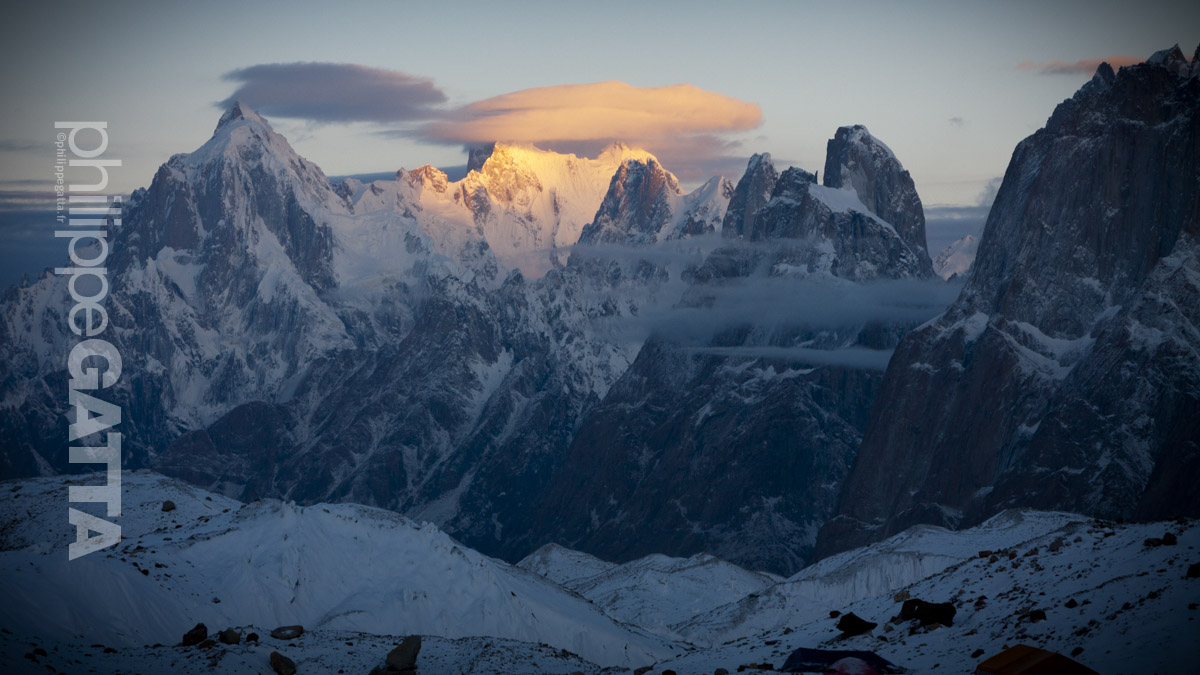
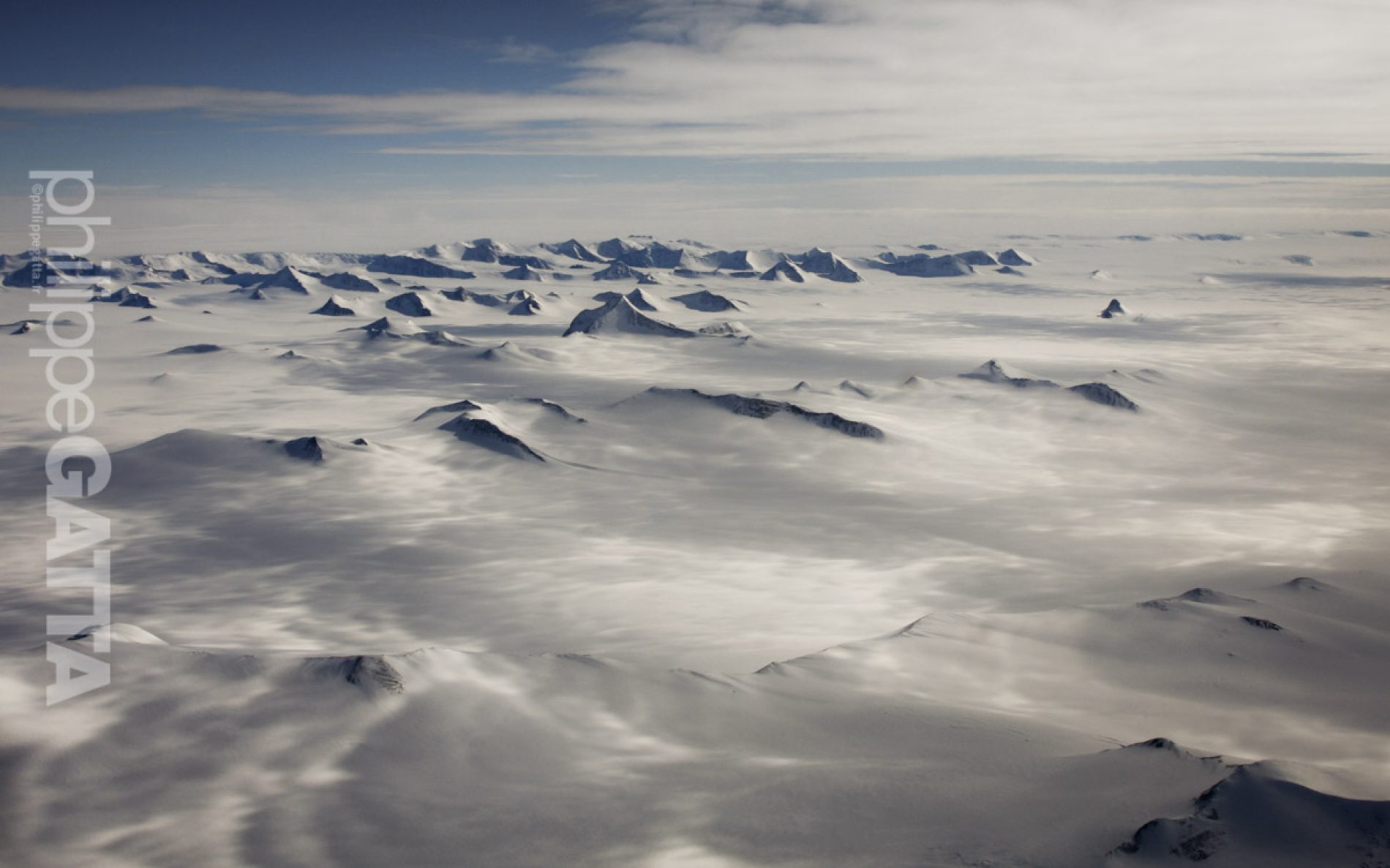
Mount Vinson (or Vinson Massif) is the highest mountain of Antarctica and reaches 4892 m (16,049 ft). It is located in the Ellsworth Mountains Range, only 1,200km (750 mi) away from the South Pole. Temperatures in the Ellsworth Mountains average around -30 °C (-20 °F). The best months for expeditions are December through February.
The massif has been discovered in 1957 and the top reached for the first time in 1966. As of today around 1,000 climbers (only 17 French) have succeeded Mt. Vinson, much less than Mt. Everest.
The Mt. Vinson is part of the 7 Summits Challenge which consists in climbing the highest mountain of each of the 7 continents.
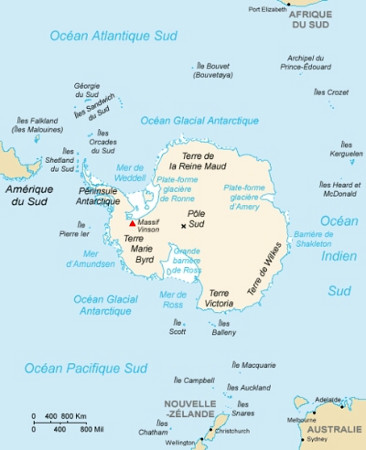
Antarctica
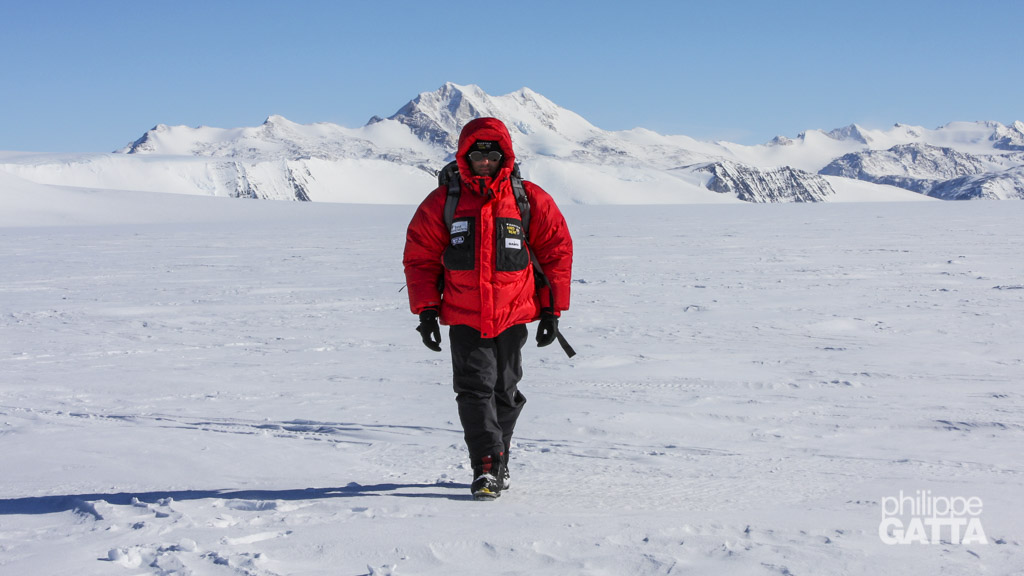
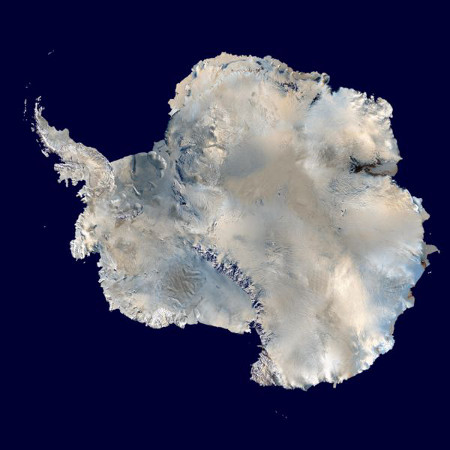
Antarctica is coldest, driest and windiest continent, and has the highest average elevation of all the continents.
Some 98% of Antarctica is covered by ice, which averages at least 1.6 kilometers (1.0 mi) in thickness and can reach up the 4.5 km (2.8 mi). The continent has approximately 90% of the world’s ice (and thereby approximately 70% of the world’s fresh water). If all of this ice were melted, sea levels would rise about 200 feet (60m).
Antarctica is about 1.3 times larger than Europe (14 million km² / 5.4 million sq mi). It has no permanent residents, but approximately 4,000 people in summer to about 1,000 in winter are conducting scientific research.
Antarctica is the coldest place on Earth. It is a frozen desert with little precipitation; the South Pole itself receives less than 10 cm (4 inches) per year, on average. Temperatures reach a minimum of between -80 °C and -90 °C (-112 °F and -130 °F) in the interior in winter and vary between -30 °C and +5 °C (-22 °F and 41 °F) in summer.
The lowest temperature on Earth of −89.2 °C (−128.6 °F) was measured at Vostok Station.
The strong Katabatic winds off the polar plateau often blow at storm force and can reach 300km/h (187 mph).
The Expedition
Dec 12-15: France - Punta Arenas
Flight from France and expedition preparation at Punta Arenas in Patagonia, Chile.
Dec 16-18: stuck at Punta Arenas
Stuck at Punta Arenas, bad weather at Patriot Hills (Antarctica).
Dec 19: Punta Arenas - Patriot Hills
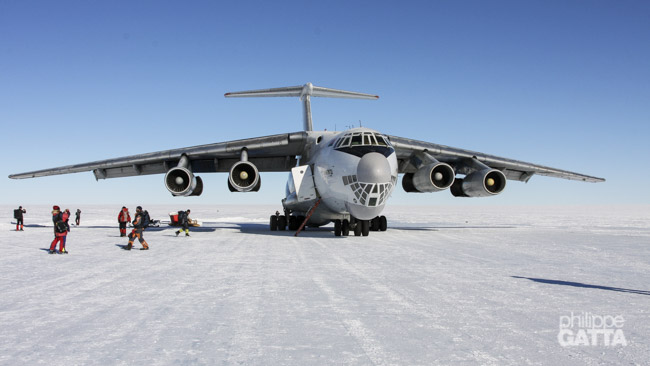
Flight from Punta Arenas to Patriot Hills (Antarctica) with a Russian cargo plane.
Patriot Hills is the Adventure Network International’s base camp since 1987. Located at an elevation of 1000 m (3,280 ft) by 80º19′ latitude South and 81º16′ of longitude West, this camp is 3000 km (1,875 mi) away from the closest city and only 1075 km (670 mi) from the South Pole. It is the starting point of most Antarctica expeditions. We arrived at Patriot Hills around 17h.
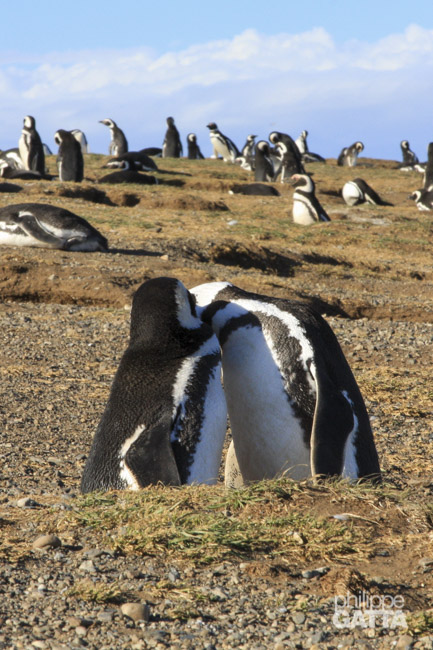
Dec 20-22: stuck at Patriot Hills
Stuck at Patriot Hills in bad weather.
Dec 23: Patriot Hills - Vinson Base Camp (2100 m) - Half Camp (2500 m)
Good weather, we finally could fly to Vinson base camp. We took the 3rd of the 6 planes and took off at 17h. The flight was absolutely fantastic. The sky was clear except some clouds on the Vinson Massif itself. We landed at Vinson Base Camp (BC, 2100m) at 18h where we got a briefing from ALE staff. We sorted out the gear and food for the upper camp, loaded it on the sleds and buried everything else in a cache. At 21h we left BC in 2 rope teams of 3 and reached half camp 3h later in the clouds. By the time we pitched the tents, melted snow and ate it was 2h.
4.5km, +400m, 3h.
Dec 24: Half Camp (2500 m) - Low Camp (2750 m)
We were in the clouds when we woke up with a temperature -20ºC. It improved as we walked up the Branscom glacier and finally got warm. Taking our time, we reached Low camp at 19h30. We pitched our 3 tents and built snow walls to protect them from the wind. Taking advantage of 24h of sunlight, we went to sleep late.
4.5km, +250m, 4h30.
Dec 25: bad weather at Low Camp (2750m)
After a long hesitation due to the bad weather, we finally decided to stay at LC rather than doing the load carry to the high camp. We lost another day after the long wait at Punta Arenas and Patriot Hills.
Dec 26: Low Camp (2750 m) - High Camp (3710 m)
In the morning the weather was like the day before. After a few more discussions, we decided to change our plan and go to High camp in one push instead of doing a load carry and a do a 2nd climb the day after. We saved one day but had to carry everything at once in 25kg rucksack.
Like every other teams this year we also decided to climb via the new route to avoid the crevasses and ice falls of the headwall. It took us several hours to take the tents down, make a cache to leave some gear, food and one of the 3 tents. We finally left LC at 15h by -25ºC and in the clouds. Not for long, we went above the sea of clouds at 3100m and enjoyed great views over Shinn, Gardner, Epperly and Tyree.
We climbed the ridge in 6h and continued the climb on the glacier toward the HC. A cold wind started to blow. We reached HC at 23h30 and had to pitch the tent, build wall and cook in windy and cold conditions (-17ºC in the tent). It was 2h30 when we went in hour sleeping bag.
4km, +1000m, 8h30.
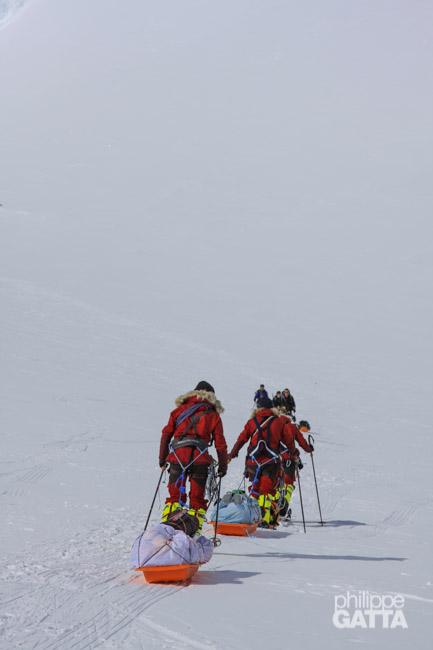
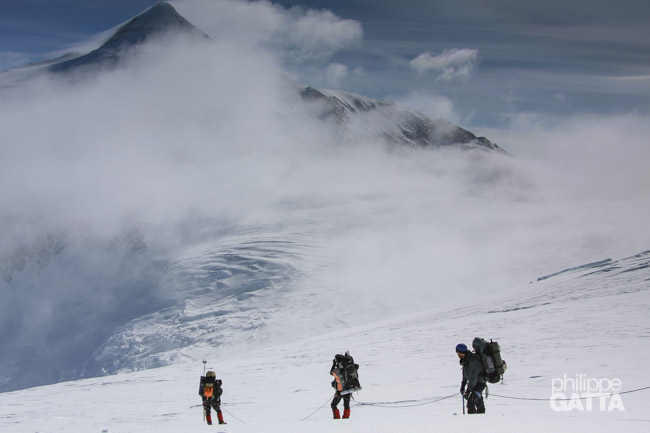
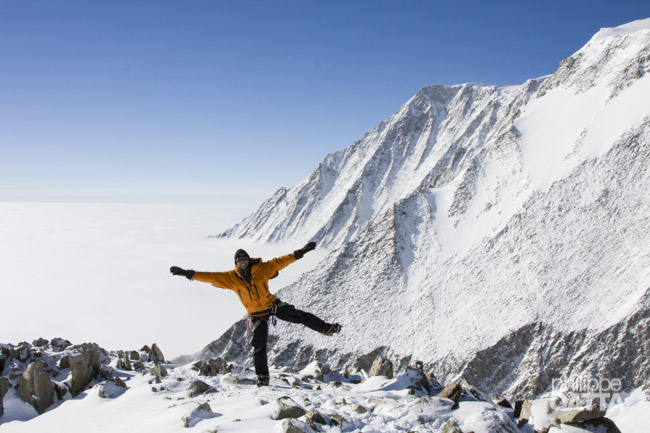
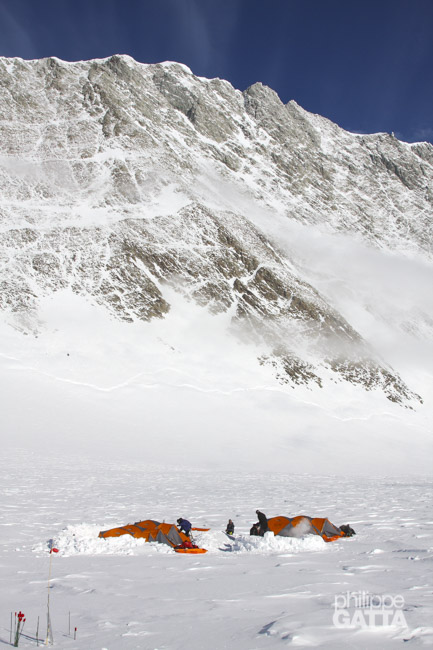
Dec 27: rest day at High Camp
Dec 28: High Camp (3710 m) - Mt Vinson Summit (4892 m) - High Camp (3710 m)
We woke up at 7am, started boiling water, eating and preparing for the summit bid. We finally left the HC at 9h45 under a great weather: -25ºC, clear sky and light wind.
We passed 4200m at noon, the wind started to raise and temperature dropped a little. We put on the down pant, hand warmer and big mittens. As planned we headed toward the gully instead of the normal route. Unfortunately the snow / ice was harder than excepted and without proper gear (2 ice axes each, ice screw…), we decided turn back and join Vinson’s normal route. We lost almost 2h and some energy but more concerning, the clouds started building up toward Shinn and around us.
We finally reached the summit of Vinson at 19h in poor visibility, clouds. 2h30 later we were back at High camp.
14km, +1230m / -1230m, 12h30.
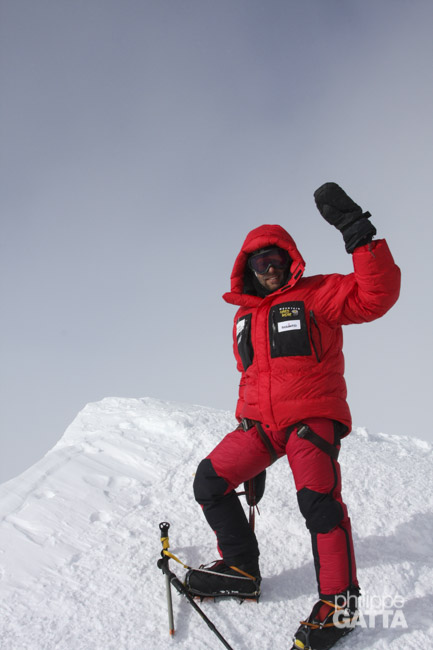
We finally reached the summit of Vinson at 7pm in poor visibility, clouds and a windchill of -45ºC.
Dec 29: High Camp (3710 m) - Mt Vinson Base Camp (2500 m)
We heard in the morning from BC that the Twin Otters were expected at 18h. We put the tents down, cleared the camp and left again with 25kg rucksack at noon. The weather conditions were better than in the last 3 days, it would have been perfect for a summit day. We reached Low Camp at 14h10 and got an update about the flights; the conditions at Patriot Hills were so bad that no plane could fly out or in. So we took our time to gather the food and gear left there and we put everything on the sleds. We were the last Team on the Mountain. We roped up in two teams of 3. The weather was still good until half camp where we entered into the clouds. We finally arrived at BC at 18h10. The weather hadn’t improved at PH and all flights were canceled that day. Like all other teams, we pitched our tents to spend one more night in the Vinson Massif. It was midnight when we could finally sleep.
14km, -1760m, 5h.
Dec 30: Vinson Base Camp (2500 m) - Patriot Hills - Punta Arenas
The weather improved in the morning and could fly to Patriot Hills and then to Punta Arenas.
Environment
Expedition members followed the rules defined in the Antarctic Treaty of 1959. No trash and garbage have been left during the expedition, everything has been brought back to the base camp and then to Chili.